

Backpack, sling or duffel — built for how you carry and reach your things, not just what fits inside.
8 min read
A school backpack, a gym duffel and a court sling bag can hold roughly the same amount and still be completely wrong for each other's job. The 3 Piece Backpack Set and the Gym & Travel Duffle Bag both sit around 30 litres, yet one is built to sit flat on your back through a full day of classes and the other is built to hang open on a gym bench while you dig out trainers. Capacity tells you how much fits. It doesn't tell you how you'll get at it.
This guide compares the three bags in our bags range — a backpack, a sling and a duffel — built for three different everyday jobs: school and commuting, court sports and the gym or a weekend away.
Backpack, sling or duffel: quick overview
| Bag type | Best for | Main advantage | Think about |
|---|---|---|---|
| Backpack | School, college, commuting, everyday kit | Hands-free, weight balanced across both shoulders | Comes off, or gets reached behind you, to get into — built to be worn, not opened on the move |
| Sling | Tennis, pickleball and other court sports | Fast to grab and put down between games | Less overall room than a full-size bag — built for one activity's kit |
| Duffel | Gym, training, weekends and travel | Wide-opening main compartment, easy to pack bulkier or damp kit | Carried by hand or one shoulder strap rather than worn hands-free |
What changes between bag types
Capacity numbers look similar across these three, but the way you load and reach into each one is different, and that matters more day to day than a litre count.
Carry method. A backpack sits on both shoulders and leaves your hands free — the point of a backpack. A duffel is carried by hand or one shoulder strap, which is fine for a locker room or a car boot but less practical for a walk or a cycle. A sling crosses one shoulder and sits at your hip or back, built to be grabbed and put down quickly between games rather than worn all day.
Access while you're carrying it. A duffel gives broad, wide-opening access once you set it down — built for digging out trainers or stuffing in damp kit at the end of a session. A sling can swing round to the front for quick access between points without taking it off. A backpack generally needs to come off, or be reached behind you — it's built to be worn, not opened on the move.
Organisation for the activity. A laptop sleeve and a pencil case matter for school. A dedicated shoe compartment and a water-resistant pocket for a damp towel matter for the gym. A padded sleeve sized for a racket or paddle matters for court sports. None of these are interchangeable between activities — a bag without the right compartment doesn't stop you carrying that item, it just means everything sits together instead.
Capacity in real terms. A litre figure doesn't tell you the shape of what you're packing. Books and a laptop pack differently from folded clothes and trainers, which pack differently again from a racket, balls and a water bottle.
The bag that fits your day isn't the biggest one or the cheapest one — it's the one built around how you need to carry and get at what's inside.
Best bags for school, court sports and the gym
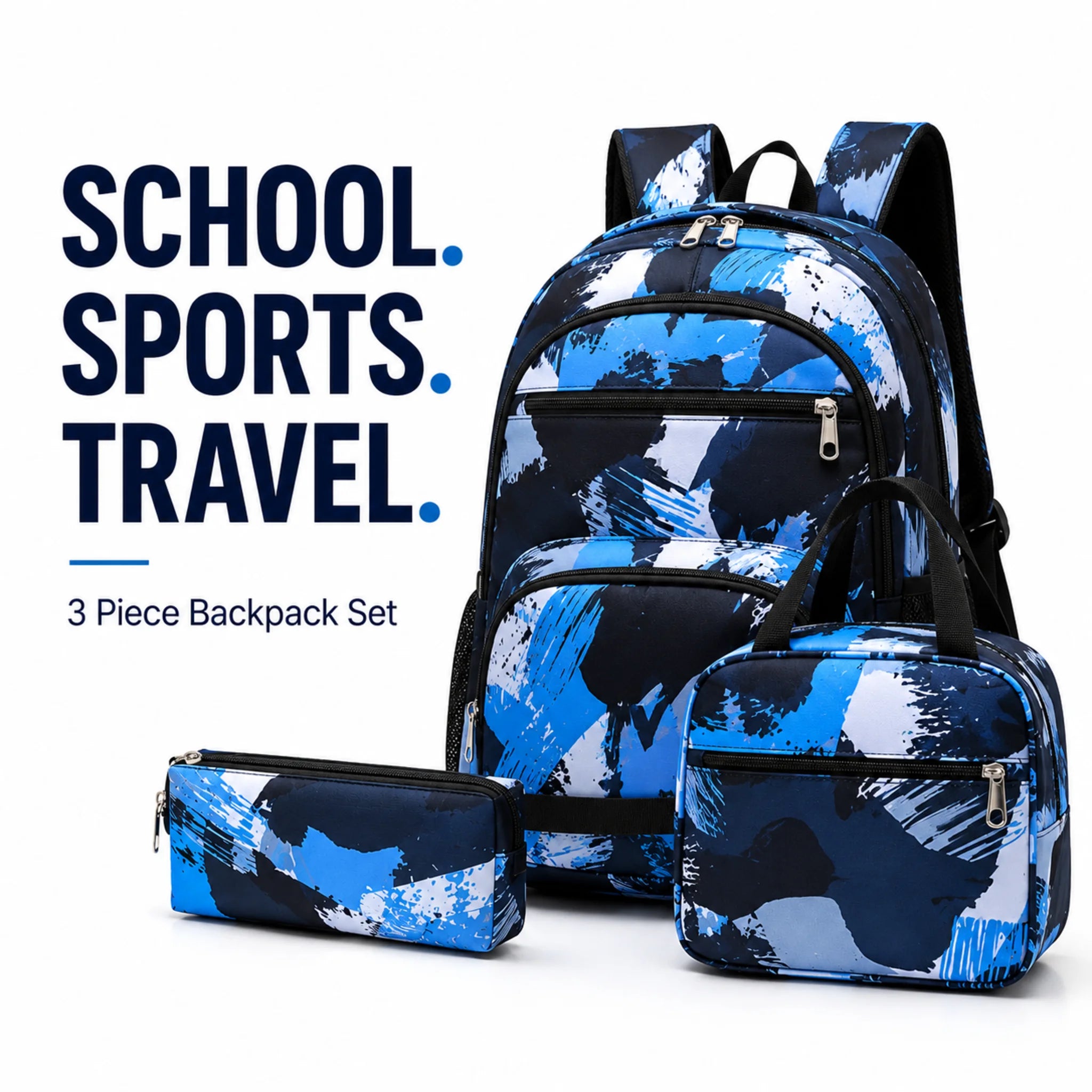
For school, college and commuting: 3 Piece Backpack Set
The 3 Piece Backpack Set pairs a 47 × 33 × 20cm, roughly 31 litre backpack with a matching insulated lunch bag and a flat zip pencil case — one coordinated set built on the idea that a bag rarely does just one job, rather than three separate purchases.
The backpack has an internal laptop sleeve for devices up to 15 inches, mesh side pockets for a water bottle and wide, padded, adjustable shoulder straps with a breathable mesh back panel. The water-resistant Oxford fabric exterior and nylon lining mean a wet school run doesn't automatically mean wet books.
It's sized for secondary school, sixth form, college, university, commuting, gym visits and weekend travel, and suits ages ten and up. The lunch bag has its own carry handles and a wipe-clean insulated lining, and the pencil case keeps pens, cables and small accessories separate from everything else.
For tennis and pickleball: Tennis & Pickleball Sling Backpack
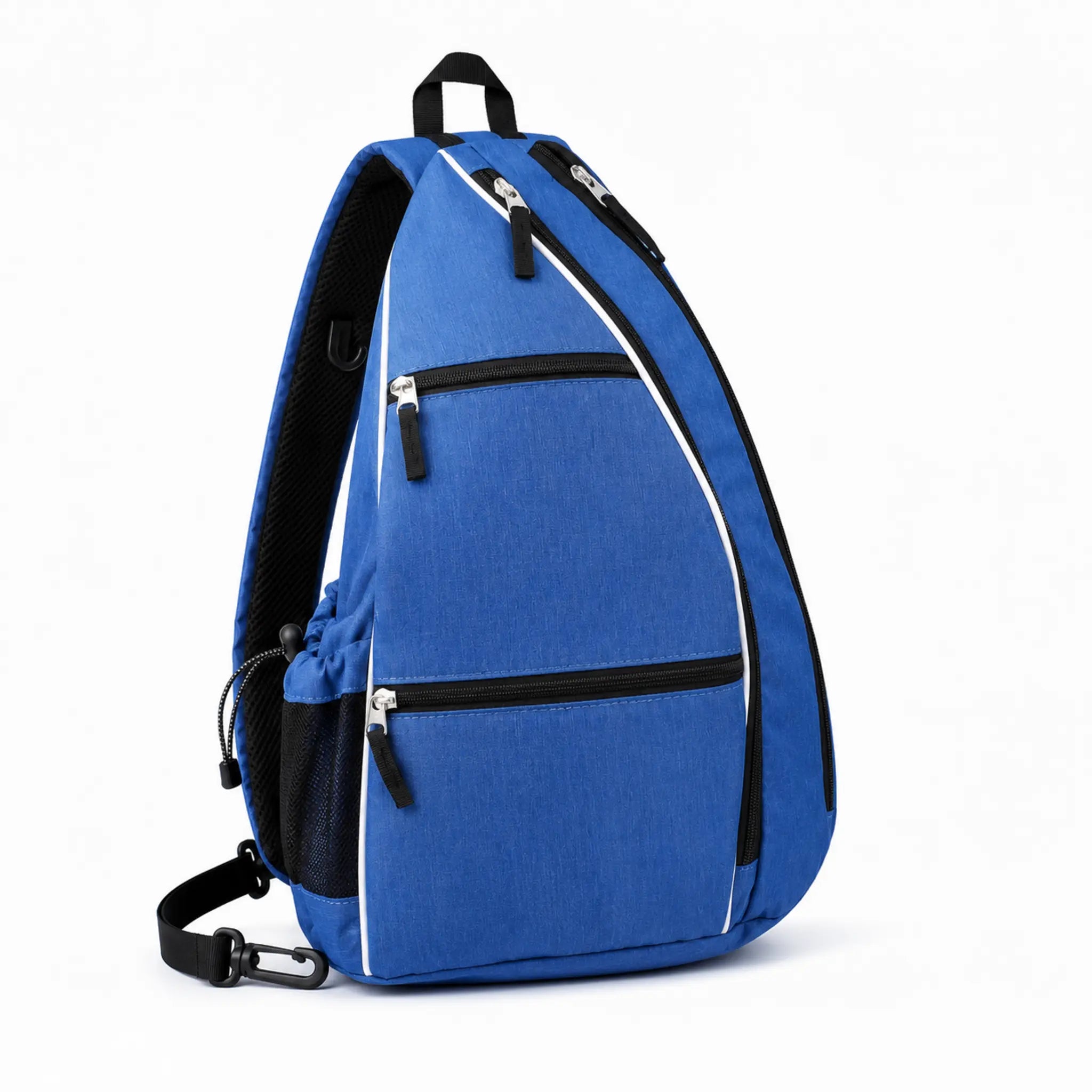
A sling starts to make sense when the awkward item in your kit is the racket or paddle itself — nothing else in a normal bag is built to keep it protected while making the rest of your court kit easy to reach. The Tennis & Pickleball Sling Backpack solves that with a convertible carry system: zip the two straps together for a supported backpack carry when you're walking further or carrying more, or unzip them to a single diagonal sling for quick access between points once you're at the court.
A padded sleeve protects one or two rackets or paddles, with a separate main compartment for clothing and a towel, a front zip pocket for a phone and wallet, a lower zip compartment for balls and accessories and an elasticated side mesh pocket for a water bottle. At 46 × 35 × 16cm and 0.3kg, it's built to be light and quick to grab rather than to double as an everyday bag.
The waterproof Oxford polyester exterior and padded, breathable mesh back panel carry over from the backpack set, along with a reinforced carry handle for when neither backpack nor sling mode is what you want.
For the gym, weekends and travel: Gym & Travel Duffle Bag
A duffel starts to make more sense once shoes, clothing and wet kit all need their own space rather than piling in together. The Gym & Travel Duffle Bag is built around exactly that: its roughly 32 litres break into a main compartment for clothing and daily items, a separate lower compartment for shoes and a water-resistant side pocket for a damp towel or wet kit.
An open elasticated pocket and a flat internal sleeve keep smaller items and documents apart from the rest; a rear luggage sleeve lets it sit on top of a wheeled case for travel; and front webbing straps hold a yoga mat on the outside when the main compartment's already full. At 46 × 25 × 28cm and 0.46kg, it carries by hand, over one shoulder with the detachable adjustable strap, or slides onto a case handle.
It's built for training, but the same features — a separate shoe compartment, a spot for damp kit, room for a change of clothes — carry over directly to a weekend away or a few days' travel.
Can one bag cover more than one job?
To an extent, yes — and it's worth being honest about where the overlap is rather than assuming you need all three. The 3 Piece Backpack Set's own design leans into this: the same set is meant to carry books through a school week, kit to a training session and lunch to a desk the next morning, so if your gym trips are occasional and you're not carrying wet kit or trainers separately, the backpack alone covers both without needing a second bag. The Gym & Travel Duffle Bag is built for training and travel in the same breath, so a weekend bag and a gym bag genuinely can be the same purchase.
Where a dedicated bag earns its place is when the activities collide, not just coexist. A laptop and a spare pair of trainers can share a backpack occasionally without much trouble; a laptop and a soaked towel can't share one for long before one of them suffers. The sling bag is the clearest case for staying dedicated — its racket sleeve and ball compartment don't do anything useful for school or the gym, so it only earns a place in the rotation if you're playing tennis or pickleball regularly.
The practical rule: if two activities are occasional and don't conflict on what needs keeping separate, one bag can do both. If one of them happens often enough to need its own dedicated space — or involves kit the other bag has nowhere to put — that's when a second, purpose-built bag pays for itself.
Comparing the three bags
| Bag | Capacity | Dimensions | Carry style | Best for |
|---|---|---|---|---|
| 3 Piece Backpack Set | ~31 litres | 47 × 33 × 20cm | Backpack, both shoulders | School, college, commuting |
| Tennis & Pickleball Sling Backpack | Sized for 1–2 rackets plus court accessories (litres not stated) | 46 × 35 × 16cm | Converts backpack ↔ single diagonal sling | Tennis and pickleball |
| Gym & Travel Duffle Bag | ~32 litres | 46 × 25 × 28cm | Hand, shoulder strap, or case-mounted | Gym, weekends, travel |
Which should you choose?
Carrying books, a laptop and everyday items through a full day → the 3 Piece Backpack Set.
Heading to the court with a racket or paddle and the essentials to go with it → the Tennis & Pickleball Sling Backpack.
Packing clothes, shoes and training kit for the gym, a weekend or a short trip → the Gym & Travel Duffle Bag.
Need one bag to cover more than one of these → choose based on the bulkiest regular load, not the occasional one. The bag built for your most demanding regular use will usually stretch to cover the lighter, occasional one too — the reverse is rarely as comfortable.
Once you know which one fits your day, the full range — every size and colour across all three — is in our bags collection.


